


Most players check their Aimlabs Benchmarks rank once, feel something about it, and move on. Either they’re happy with where they landed or they’re quietly frustrated that the number doesn’t feel like it reflects how well they actually play. Both reactions are understandable, and both are usually missing some important context about what the rank is actually telling you.
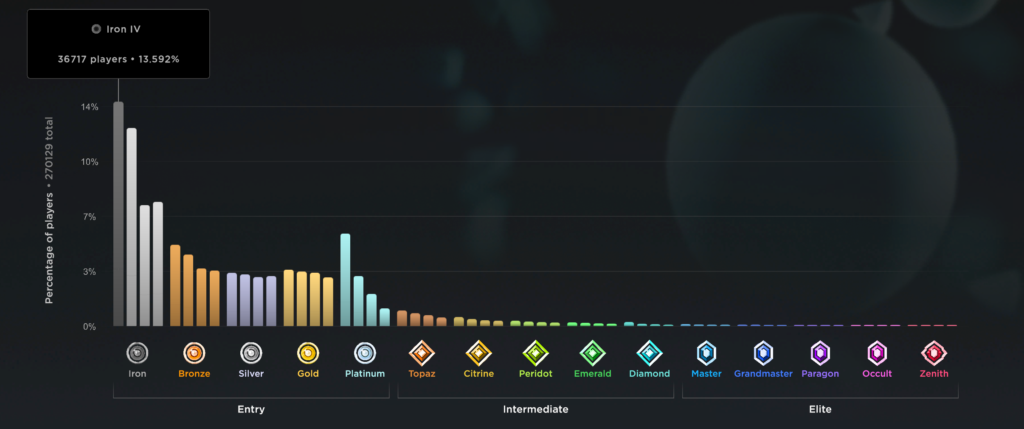
The current season has 270,106 ranked players on PC. Here is what that distribution actually looks like, and what your rank is really measuring.
How Your Rank Is Actually Calculated
The Benchmarks assess your aim across three broad categories, Tap, Track, and Switch, each broken down into subcategories. Your highest score in each subcategory counts toward your overall skill point total, and that total determines your rank. The system takes your best result per subcategory, so if you played Lasertrack Entry twice and scored higher on the second attempt, that’s the number that counts.
That last part matters more than most players realize. If you played through the Benchmarks quickly, taking one attempt at each task and moving on, there is a reasonable chance your score doesn’t actually reflect your ability. A bad warmup run, a particularly challenging run with the target behaviors, a moment of distraction, or simply not being dialed in that day can drag a subcategory score down in a way that sticks until you go back and beat it. Before you draw conclusions about where your rank stands, it’s worth asking honestly whether you gave each task a genuine effort or just a single pass.
The other thing the scoring system means is that your rank reflects your weakest areas as much as your strongest ones. Your rank is not a ceiling on your best skill, it’s a floor set by your least developed one. A player who is exceptional at flicking but hasn’t meaningfully engaged with the tracking or switching tasks will be ranked lower than their flicking alone would suggest. The system rewards coverage across all categories, not just depth in one.
Where Most Players Are
Iron 4 is the single most populated rank in the entire system at 36,711 players, which makes sense as the natural starting point. Iron as a whole contains roughly 110,000 players, just over 40% of the entire ranked population. The distribution through Bronze, Silver, and Gold is relatively flat before a notable spike at Platinum 4, which jumps to 15,323 players. This clustering effect likely reflects players who have put in consistent training time across all categories and are converging around that threshold. The drop from Platinum 4 to Platinum 1 is significant, falling from 15,323 down to 2,783, the sharpest intra tier drop in the entire Entry bracket.
The Intermediate Reality Check
Reaching Topaz 4, the very first rank of Intermediate, puts you in roughly the top 3% of all ranked players. Only about 7,800 players out of 270,106 have made it into Intermediate at all. The Diamond tier is where things get particularly dramatic. Diamond 4 has 491 players. Diamond 1 has 23. That is a 95% dropout rate within a single rank, which is unlike anything else in the system.
Elite Is a Different World
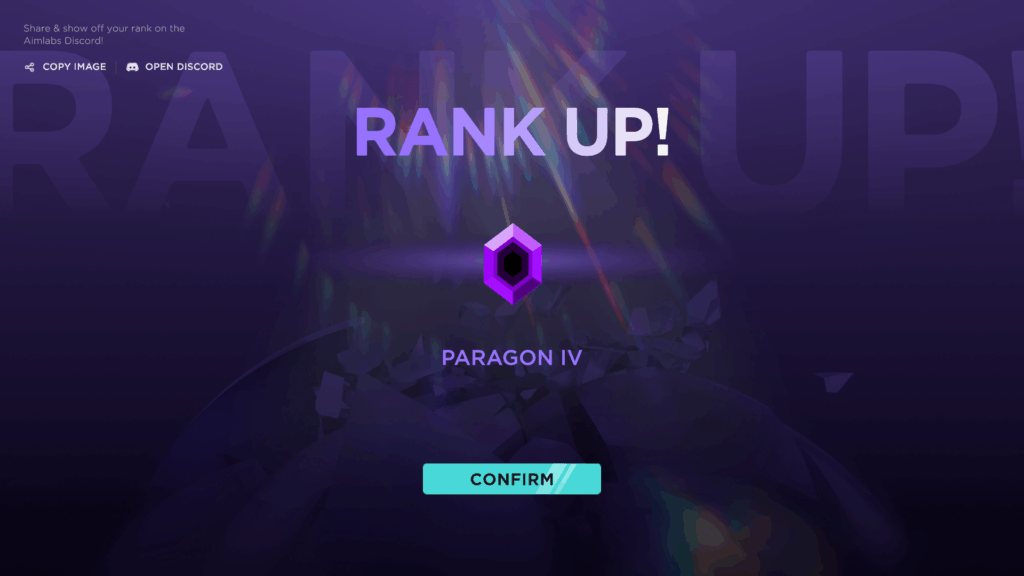
The entire Elite tier, from Master through Zenith, contains approximately 466 players. That is 0.17% of the ranked population. The Zenith tier itself has an interesting inversion where Zenith 1 has 12 players while Zenith 4 has only 1, which shows that the players at the top end of the spectrum likely have the ability to plow through the Zenith ranks entirely.
What To Do If You Feel Stuck
If your rank feels discouraging, the first question to ask is whether you genuinely completed the Benchmarks or left sections unfinished. An incomplete run will underrepresent your actual ability regardless of how strong your best categories are. Go back and finish what you started before drawing conclusions.
The second question is whether you gave each task a real effort. A single attempt on a bad day is not a score. Go back to the tasks where your numbers felt low and give them a few more runs. You may find the rank moves more than you expected.
If you have done both of those things and you are still hitting a wall in a specific area, that’s useful information rather than a dead end. The Benchmarks are telling you where your aim needs the most work, and Aimlabs has tasks and playlists built around exactly those mechanical demands. Spend some time training those specific subcategories, whether that’s a targeted playlist, an Aim Basics Routine, or individual tasks that address the skill you’re struggling with, and then come back to the Benchmarks periodically to measure whether the training is moving the needle. Progress in aim is rarely linear, but it shows up in the numbers when you give it time and effort.
What Your Rank Actually Means
If you are in Iron or Bronze, you are exactly where most people start. Work through the full task set before worrying about where you land.
If you are in Silver or Gold, you are around the median. Pushing your weakest subcategories will move your rank more than grinding your strongest ones.
If you are in Platinum, you are approaching the top quarter of ranked players. The Platinum 4 spike in the distribution suggests this is a common plateau, and the path through it usually runs through deliberate practice in the areas where your scores feel hardest to improve.
If you are in Topaz or above, you are in the top 3% of everyone who has completed a Benchmarks run.
If you are in Diamond, you are in rare company. The numbers make that clear.
If you are in Elite, there is not much more to say. You already know.