

You’re Improving. Here’s How to Actually See It

Improvement in aim training is rarely going to appear as a dramatic change… It doesn’t happen in a single session or even across a single week. It accumulates slowly, through hundreds of small adjustments and repetitions that, individually, could feel unremarkable.
The problem with slow progress is that it’s so easy to miss. When you are living it day to day, a plateau can feel permanent, even when you are actually moving forward and making incremental progress. The players who stay motivated through the difficult stretches are usually the ones who have found a way to make their own progress visible, not just to themselves in the immediate moment, but to themselves looking back from three or six months down the road.
Why Visibility Matters for Motivation
Think about the last time your aim felt like it stopped improving… Chances are, you were comparing how you felt in that moment against a vague memory of your best sessions, rather than against where you actually were when you started.
That comparison will almost always be unfair to yourself. If you’re looking back without concrete reference points, progress is invisible, and plateaus can feel like a total backslide. Having a record of where you were can change that completely. A difficult stretch looks different when you have evidence that you have been through difficult stretches before and come out the other side with measurably better mechanics. The record does not make the plateau any easier to push through, but it does help you keep perspective as you work on it.
Direction Through Your Own Data
Tracking your progress over time will do more than keep you motivated, it also makes you a smarter trainer. Looking back at your own history tells you which sessions moved the needle and which felt productive but did not translate into real improvement. It tells you which mechanical categories or disciplines you’ve consistently struggled with, and which ones have responded well to focused training. Without that record, you’re always making decisions based on how things feel in the moment, rather than on what has actually worked for you specifically. Your own training history is the most relevant data you have, and most players never look at it.
The Daily Habit: End of Session Notes
The simplest version of progress tracking is a brief note at the end of each training session. It doesn’t have to be long, you don’t have to write a daily diary. What you worked on, how it felt, and what you want to focus on next time is enough.
The goal is not to write a detailed analysis but to create a reference point that you can look back on and review. Over time, these notes start to reveal patterns that are usually invisible. You might notice that your reactive tracking consistently improves after sessions where you warmed up with lighter tasks first, or that your flicking feels noticeably worse on days when you jumped straight into more challenging tasks. Those correlations are genuinely useful, and you will only see them if you have been tracking your training data.
Keeping the habit brief is important because it’s what makes it sustainable. Five minutes at the end of a session is something you can actually maintain without it feeling like a drag on your process.
The Monthly Snapshot: Benchmarks as a Baseline
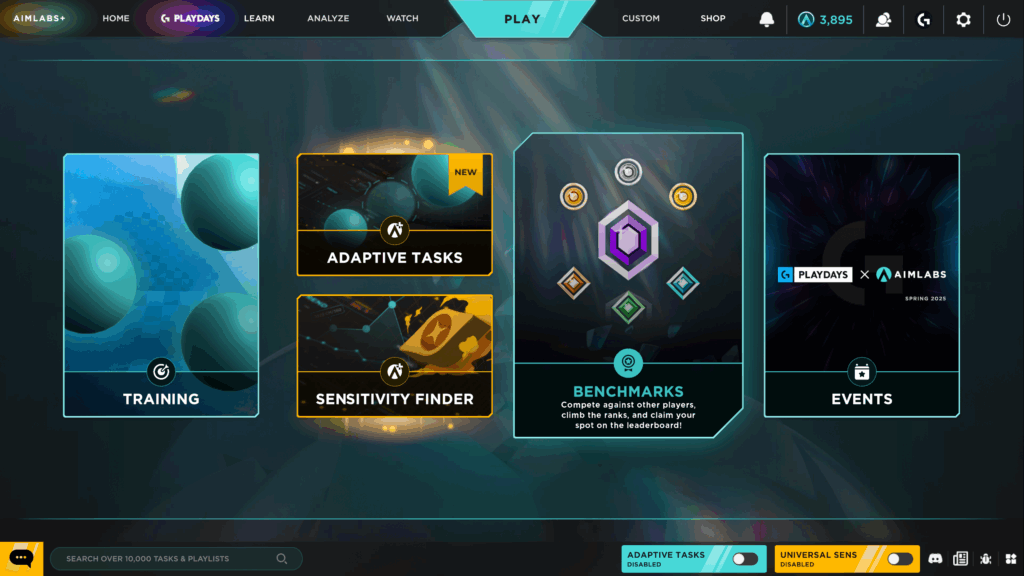
Alongside the daily habit, taking a periodic snapshot of your Benchmarks can give you a broader view of where you stand across your aim categories. Running Benchmarks once a month and screenshotting your results creates a before and after record that daily notes can’t provide on their own. Six months of monthly snapshots give you a concrete, specific timeline of your development, rather than a vague impression of whether you feel you have gotten better. It also helps you identify which categories have responded to your training and which have stayed flat, directly informing what to focus on in the next training block.
Putting It Together
The daily note and the monthly snapshot work together, creating a bigger picture of your overall progress. The daily habit keeps you connected to your training process in real time, and the monthly snapshot gives you the long view. Between the two, you have a record of your journey that makes improvement visible even when it does not feel that way.
If you’re starting today, take a Benchmarks screenshot as your baseline before your next session, and write a few sentences after that session about what you worked on and what you noticed. Those two things together are the beginning of a training record that will be genuinely valuable to look back on.