
Hitscan vs Projectile: Understanding How Your Aim is Impacted

Have you ever switched from one hero to another in Marvel Rivals or Overwatch and suddenly felt like your aim completely fell apart? There is a good chance you just switched from a hitscan weapon to a projectile one. It is one of the most common sources of frustration for players who feel like they are aiming well but not hitting, and once you understand what is actually happening, a lot of things start to make sense.
What Is Hitscan?
Hitscan is the simpler of the two. When you pull the trigger on a hitscan weapon, the game instantly checks whether your crosshair is on a target and registers a hit or miss at that exact moment. There is no bullet traveling through space, no travel time, nothing to account for. If your crosshair is on the enemy when you click, you hit them. Soldier 76’s rifle in Overwatch, Hela’s primary attack in Marvel Rivals, and all of the guns in VALORANT are hitscan. In Counter-Strike, every weapon is hitscan. The entire skill expression comes down to having your crosshair in the right place at the right moment.
What Is a Projectile Weapon?
A projectile weapon works differently. When you fire, the game creates an actual object, the bullet, the orb, or the trident, to name a few examples, and sends it traveling through the game world at a set speed. That object has to physically travel from your weapon to the target, which takes time. The faster the projectile, the less time it takes. The slower it is, the more time there is for something to go wrong.
This is where leading comes in. If a target is moving across your screen and you aim directly at them, the projectile will arrive at the spot where they were, not where they are when it lands. To hit a moving target with a projectile weapon, you have to aim ahead of them, toward where they are going to be by the time your shot arrives. How far ahead depends on two things: how fast your projectile travels and how far away the target is.
What This Feels Like in Practice
Take Mantis in Marvel Rivals. Her primary attack, the Life Energy Blast, travels at 150 m/s. That is fast enough that, at close range, you will barely notice the difference from hitscan. A target standing fifteen meters away barely has time to move before your shot arrives. But at longer ranges, the travel time becomes meaningful. If an enemy is strafing hard at forty or fifty meters, your shot needs to be placed ahead of them rather than directly on them. Players who come from Counter-Strike or VALORANT and pick up Mantis for the first time often find themselves consistently missing to the side, firing at where the target was rather than where they will be.
Namor’s trident operates similarly, but the feel is slightly different because his projectile has a visible arc to it at longer ranges. You are not just accounting for the target moving sideways; you also need to account for gravity pulling your trident slightly downward over distance, which means you aim slightly higher than you might expect at range. At close to medium range in a boxed-up fight, this barely matters, but in an open map with long sightlines, it becomes a genuine adjustment.
Rocket Raccoon’s Bombard Mode primary fire sits at 180 m/s, which is fast enough that many players treat it almost like hitscan in close quarters, and they are not entirely wrong to do so. The travel time at ten meters is so short that aiming directly at a target is close enough in most situations. His healing orbs in Repair Mode tell a different story at just 60 m/s, which is slow enough that bouncing them off walls toward injured teammates requires you to think about where they are going to be when the orb arrives, not just where they are standing now.
Apex Legends is almost entirely projectile-based, which is part of why aim training for Apex translates differently than aim training for VALORANT. The Havoc rifle is one of the very few hitscan weapons in the game, and experienced players notice the difference immediately when they pick it up. Every other weapon has bullet travel time, which is why tracking a flying Horizon player or a fast-moving Octane requires you to stay ahead of their movement rather than just keeping your crosshair on their body.
Games like Battlefield 6 add another layer to this. The game uses a system where bullets behave almost like hitscan at close range because the projectile speed is high enough that travel time is negligible in short engagements. But at longer ranges, particularly with sniper rifles, bullet drop and travel time become significant factors, and you need to aim above and ahead of where your target is standing.
How to Start Training This
The adjustment from hitscan to projectile is not just a mental one. It is a physical habit that needs to be built through repetition. Your hand needs to learn to place the crosshair slightly ahead of a moving target rather than directly on it, and that instinct takes time to develop. The good news is that once you have it, it carries over to any projectile weapon in any game because the underlying motor skill is the same; it just comes down to dialing in the slight differences in the various projectile speeds.
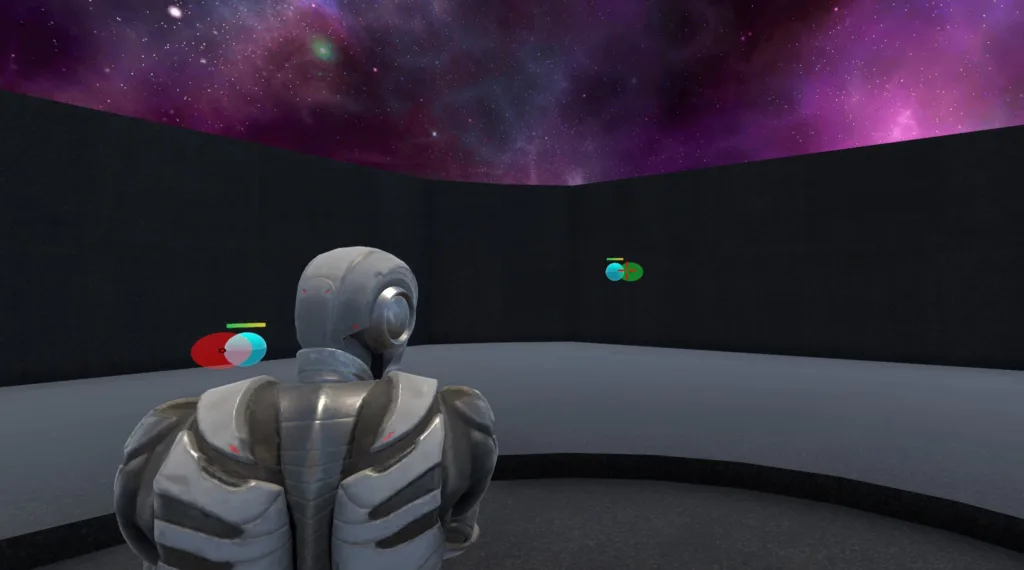
Aimlabs has tasks specifically designed around projectile mechanics, providing a controlled environment to build this habit. Tasks built for Marvel Rivals and ARC Raiders are a couple of examples that you can use to practice with projectile speeds.
If you are an Aimlabs+ member, Shot Vision is a feature worth checking out. Available under Settings, then Targets, it overlays a projected aim indicator on projectile-based tasks that shows you where to place your crosshair, accounting for the target’s movement and your projectile’s travel time. It is a learning tool rather than a scoring aid, so scores earned with it active do not count to leaderboards, but it is a genuinely useful way to visualize what leading actually looks like before you start trying to feel it out on your own.